Ankle Pain, Sprains & Joint Stability
Evidence-based acute inversion sprain recovery, chronic ankle instability management, and progressive balance rehabilitation in Swabi.
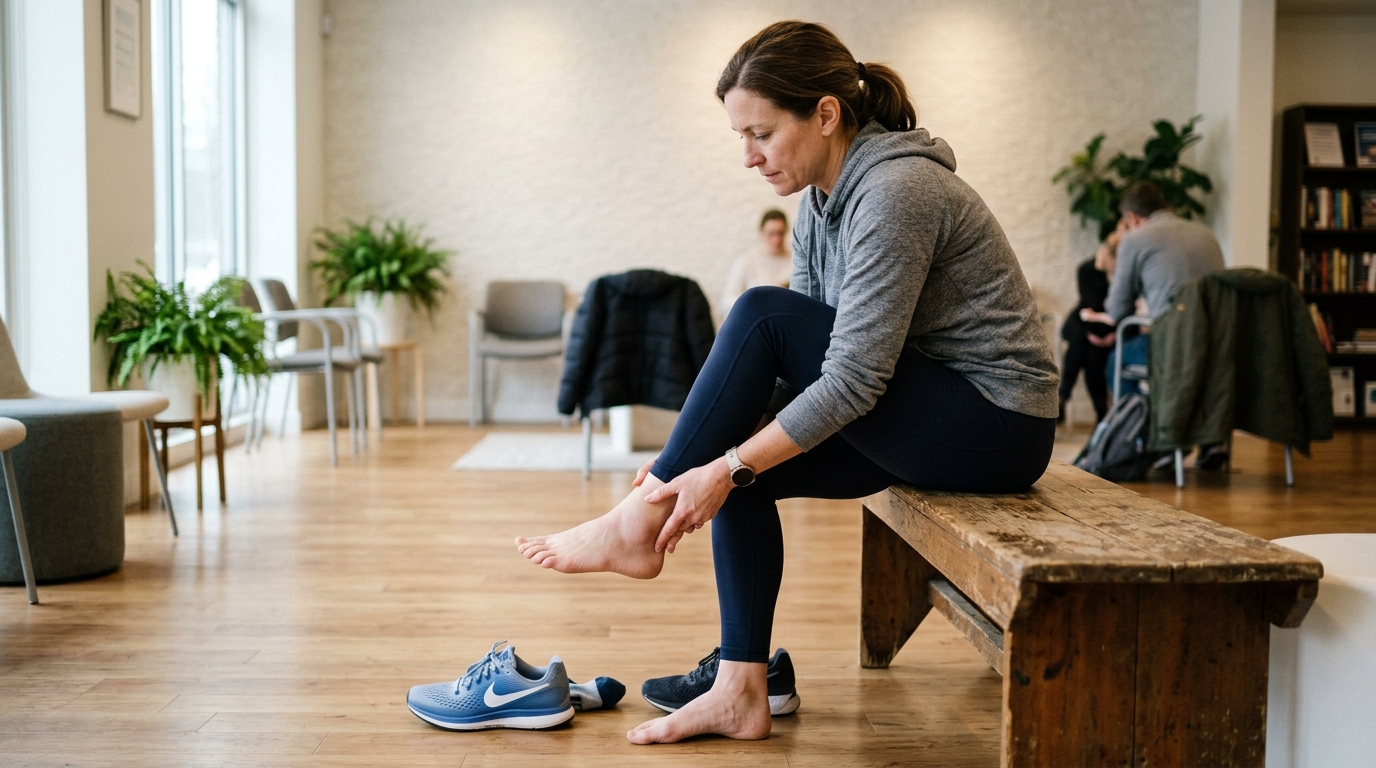
Understanding lateral ankle sprains and mechanical instability
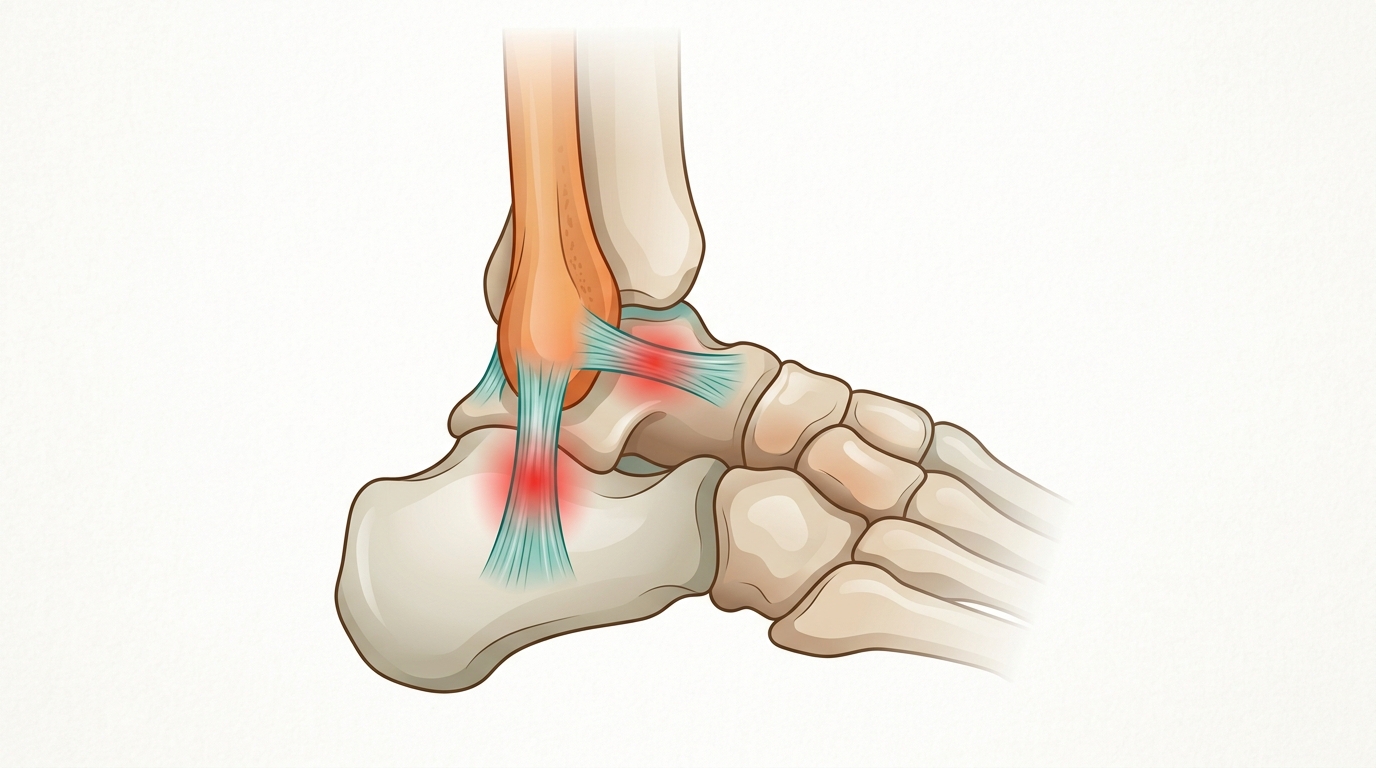
An ankle sprain occurs when the foot rapidly twists inward (inversion and plantarflexion), exceeding the elastic stretch limit of the lateral stabilizing ligaments. The anterior talofibular ligament (ATFL) is the most vulnerable and frequently torn, often followed by the calcaneofibular ligament (CFL) in higher-energy injuries.
Sprains range from Grade 1 (microscopic ligament stretching with minimal laxity) to Grade 2 (substantial partial tearing with marked swelling and ecchymosis) and Grade 3 (complete structural disruption of the ligament complex with joint instability).
Crucially, ligament damage is accompanied by tearing of joint mechanoreceptors. Without structured proprioceptive and peroneal retraining, patients are left with chronic ankle instability (CAI), recurrent rolls, and early talocrural cartilage wear.
Key indicators of acute and chronic ankle instability
Lateral Malleolar Tenderness
Sharp, throbbing pain directly over or just below the outer ankle bone, aggravated by weight-bearing and foot inversion.
Perimalleolar Swelling & Bruising
Rapid fluid accumulation around the lateral ankle within hours, frequently spreading down into the heel, arch, and outer foot.
Weight-Bearing Hesitation
Significant limp or protective antalgic gait, with inability to transfer full body weight comfortably through the injured foot.
Giving-Way Sensation
Subjective feeling that the ankle is loose or about to roll over again, particularly when stepping off curbs or walking on uneven ground.
When to seek urgent imaging (Ottawa Ankle Rules)
Seek urgent medical imaging if any of the Ottawa Ankle Rules are positive: inability to bear weight for 4 consecutive steps immediately after injury and in clinic; direct bony tenderness along the posterior 6 cm or tip of the lateral or medial malleolus; or focal bone tenderness at the base of the 5th metatarsal or navicular bone (ruling out avulsion fractures and syndesmotic high ankle sprains).
Restoring joint mobility, strength, and proprioceptive control
Phase 1: Early Functional Protection & Motion: Modern sports medicine replaces rigid cast immobilization with functional support. We utilize early protected weight-bearing, manual talocrural joint mobilization to restore dorsiflexion, and active pain-free range of motion to encourage parallel collagen fiber orientation.
Phase 2: Peroneal Muscle Strengthening: The peroneus longus and brevis act as the primary dynamic lateral stabilizers. We rebuild eccentric eversion strength and fast-twitch reactive contraction speed to dynamically catch the ankle before it can roll.
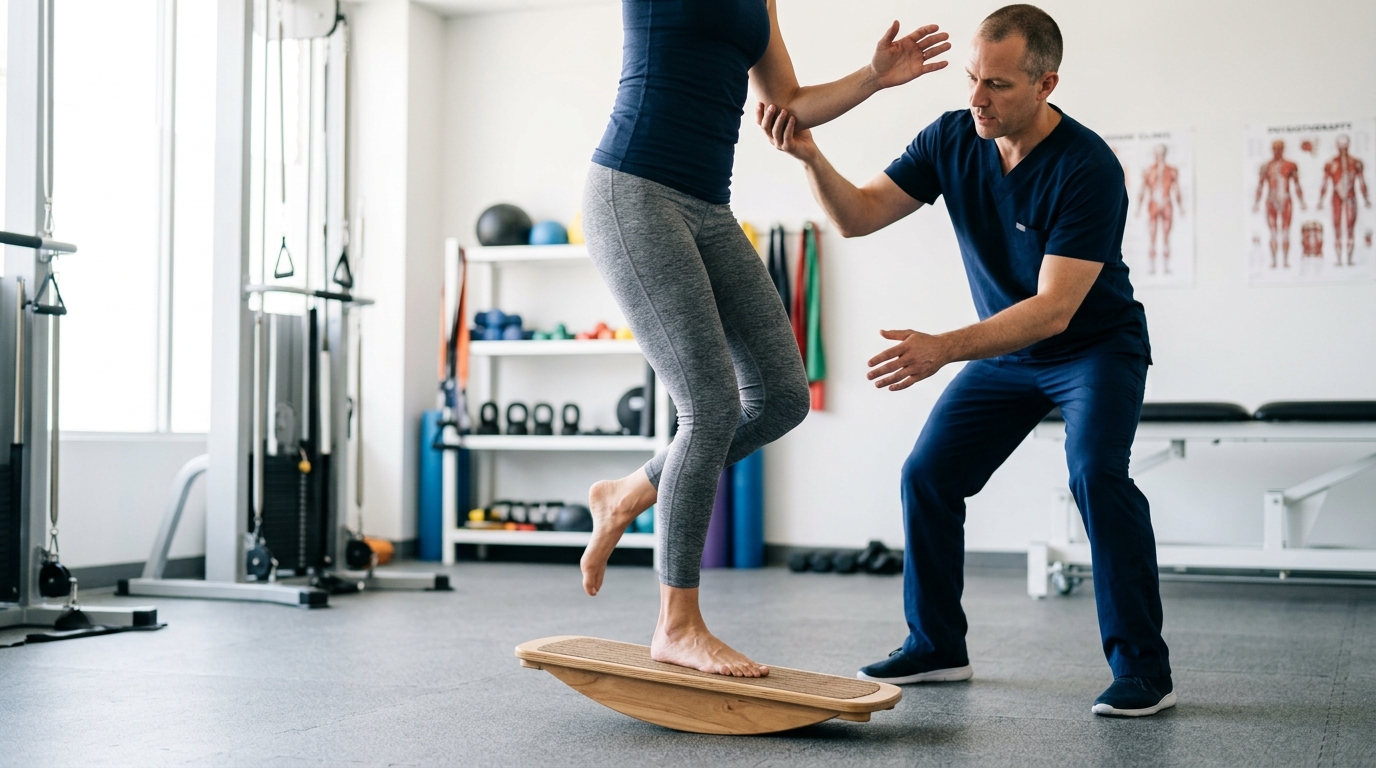
Phase 3: Sensorimotor & Agility Drills: Using rocker boards, foam pads, and dynamic perturbation drills, we retrain joint position sense (proprioception). We then progress to cutting drills, multidirectional hopping, and sports-specific decelerations.
What to expect during ankle rehabilitation
Phased Recovery Roadmap
Weeks 1–2 (Acute Protection): Swelling reduction, talocrural dorsiflexion recovery, early protected weight-bearing with support.
Weeks 3–6 (Strengthening & Balance): Progressive peroneal resistance, single-leg balance on unstable surfaces, symmetrical gait re-education.
Weeks 6–12+ (Agility & High Demand): Plyometric hopping, lateral cutting drills, bracing weaning, and full return to athletic performance.
Should I immobilize my sprained ankle in a rigid cast?
High-level clinical evidence shows that prolonged rigid cast immobilization leads to muscle atrophy, joint stiffness, and inferior ligament healing. Early functional support with a semi-rigid brace and early controlled motion produces significantly better functional outcomes.
Why does my ankle feel unstable or continue to roll months later?
Ligament injuries damage delicate proprioceptive mechanoreceptors. If neuromuscular balance and peroneal reaction time are not systematically retrained, the ankle remains vulnerable to repeated micro-inversions, developing chronic ankle instability (CAI).
When is it safe to return to running and high-impact sports?
Return to sport requires meeting objective criteria: full pain-free weight-bearing, symmetrical calf and peroneal strength, normal dorsiflexion range of motion, and passing functional hop tests with at least 90% limb symmetry.
Related lower limb & mobility conditions
Heel Pain & Plantar Fasciitis
Plantar arch biomechanics and morning heel stiffness care.
Rebuild Complete Ankle Stability & Confidence
Book a comprehensive biomechanical evaluation at Dr Waheed Physio in Swabi. We restore ligament resilience, dynamic balance, and safe return to sport.